

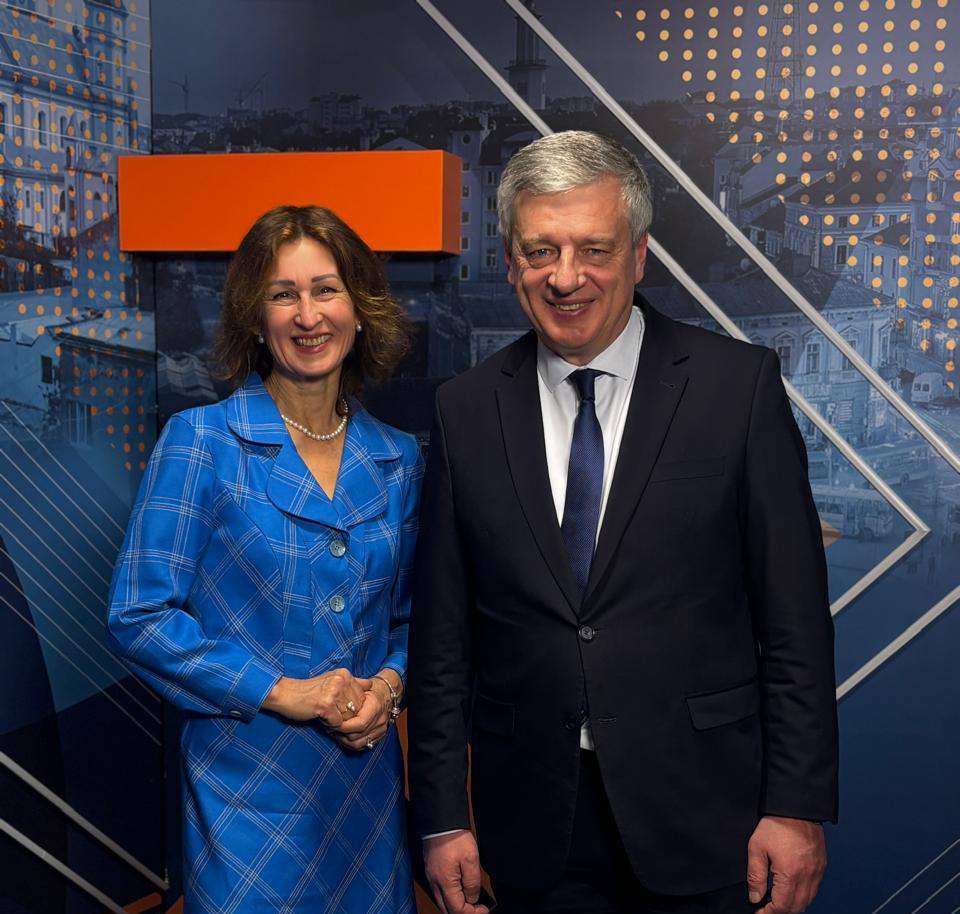
The Chairman of the Academic Council of the Vasyl Stefanyk Carpathian National University, Professor Ihor Tsependa, became a guest of the program “European Vector” on the TV channel “VEZHA”. In a conversation with the host, Olena Tretyak, he outlined the Academic Council’s key areas of activity, the priorities for developing science, the university’s role in society, and the importance of education for the future of the state.
Ihor Tsependa emphasised that the Academic Council is one of the basic institutions of the educational process, stipulated by the Law of Ukraine “On Higher Education”. It performs not only administrative functions but also serves as a kind of analytical centre of the university, shaping its strategic vision, determining the priorities of scientific research, and contributing to strengthening human resources.
Special attention was paid to the university’s scientific achievements. According to the Chairman of the Academic Council, Carpathian University is, first of all, a space of great science, where various scientific schools are actively developing. In particular, the institution is distinguished by the establishment of a powerful astronomical school and a system of star and cosmic body observation, which unites scientists from Ukraine and Europe.
Separately, Igor Tsependa focused on state support for science: this year, over 19 million 220 thousand hryvnias have been allocated for the university’s scientific research. The university is also actively developing grant activities, dividing projects into innovative ones – those that contribute to participation in international research and strengthening scientific schools – and development projects aimed at building institutional capacity.
“Today, even the war proves: if we did not have a powerful scientific potential, Ukraine would not be able to create modern defence systems that attract the attention of the world,” he emphasised.
The conversation also discussed the university’s broader mission — not only educational and scientific, but also regional. The university is an important factor in the formation of a new regional architecture, working on models to support regional development and strengthen trust in the state through education, science, and public engagement. Emphasis was placed on the role of the humanities in shaping Ukrainian identity.
Igor Tsependa noted that it is thanks to the many years of work in the humanities that a sense of belonging to one’s state is formed, without which responsible citizenship and readiness to defend the country are impossible.
Speaking about youth, he emphasised that students are not only the future but are already co-creators of the state today. Therefore, the transfer of knowledge between generations and the absence of conflict between them are extremely important, as the continuity of knowledge ensures the development of society.
The university also actively develops international cooperation. In particular, for two years in a row, Ukrainian-Polish youth debates have been held with the participation of students, diplomats and politicians. They take place at the International Centre for Meetings of Student Youth of Ukraine and Poland in Mykulychyn, which is designed to become a powerful platform for dialogue, the exchange of ideas, the implementation of innovative initiatives, and youth development.
“Without universities, no country will have either an intellectual or economic future. Ukraine is not a state that sees itself only as a service or tourist territory – we are forming our own subjectivity and future,” concluded Ihor Tsependa.
Participation in the program was an opportunity to emphasise once again the university’s role as a centre of science, education, social meaning, and a space for the formation of responsible citizenship.