

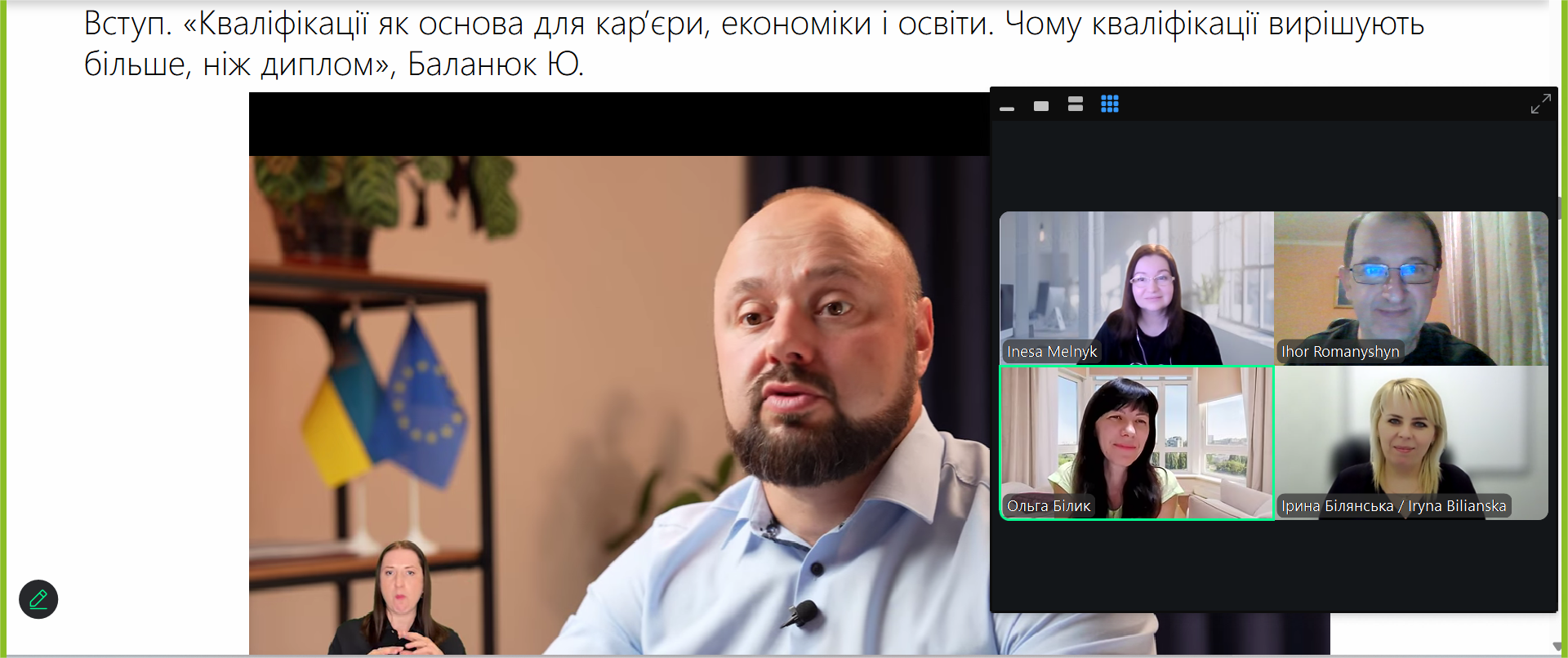
Scientific and pedagogical workers of the Department of English Philology of the Faculty of Foreign Languages - developers of the educational and professional program of the bachelor’s level of higher education “Secondary Education (English Language and Literature)” and teachers who provide the educational process in this program – associate professors Ihor Romanyshyn, Iryna Bilyanska, Inessa Melnyk and Olga Bilyk completed the distance learning course “Professional and Educational Qualifications: Current Methodological Approaches for Higher Education Institutions”.
The National Qualifications Agency developed the 45-hour course (1.5 ECTS credits).
The main speakers of the program were: Yuriy Viktorovych Balanyuk – Head of the National Qualifications Agency; Olena Volodymyrivna Eremenko – Deputy Head of the National Agency for Quality Assurance in Higher Education; Hanna Olehivna Reznik – Deputy Head of the National Qualifications Agency; Taras Mykhailovych Mandziy – Member of the National Qualifications Agency; Volodymyr Yevhenovych Bakhrushyn – Head of the Academic Council, Professor of the Department of System Analysis and Computational Mathematics of the National University “Zaporizhzhia Polytechnic”, Coordinator of the Higher Education Sector of the Scientific and Methodological Council of the Ministry of Education and Science of Ukraine, Member of the National Team of Experts on Higher Education Reform; Andriy Borysovych Poddymay – Director of the Legal Department of the Federation of Metallurgists of Ukraine (representative of the Joint Representative Body of the Employers’ Side at the National Level); Igor Anatoliyovych Baluba is the head of the expert group on the development of the system of qualifications and adult education of the Directorate of Higher Education and Adult Education of the Ministry of Education and Science of Ukraine.
The course program was aimed at increasing the professional, communication, and innovation competencies of representatives of higher education institutions to systematise the implementation of modern approaches to the development of educational programs, consistent with professional qualifications, standards, and European frameworks.
Course participants watched a series of video lectures, analysed practical cases, studied regulatory documentation and recommended sources, completed practical tasks, and successfully passed the final test.