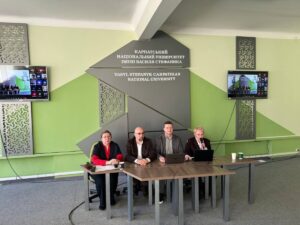
The International Scientific and Practical Conference “Transformation of Higher and Professional Education in the Era of Digitalization: Global Challenges and Post-War Prospects” was held at the Vasyl Stefanyk Carpathian National University, which brought together representatives of leading higher education institutions and scientific institutions of Ukraine and the Republic of Poland.
The scientific event became a platform for professional dialogue, presentation of research findings, exchange of international experience, and discussion of strategic directions for the development of higher and professional education in the context of digital transformations, military challenges, and the future post-war reconstruction of Ukraine.
253 participants registered to participate in the conference , including 16 representatives of foreign higher education institutions . Scientists, scientific and pedagogical and pedagogical workers, doctoral students, postgraduate students, master’s students, and representatives of student youth joined the scientific discussion.
The initiator and direct organizer of the conference was the Bohdan Stuparyk Department of Pedagogy and Educational Management of the Vasyl Stefanyk Carpathian National University in cooperation with the Ministry of Education and Science of Ukraine, the National Academy of Pedagogical Sciences of Ukraine, as well as partner educational institutions and scientific institutions of Ukraine and the Republic of Poland.
Among the conference partners are the State Academy of Applied Sciences in Chełm, the University of Rzeszów, the Marie Curie-Skłodowska University in Lublin, the Kuyavian-Pomeranian Academy in Bydgoszcz, the Ivan Franko Drohobych State Pedagogical University, the Ivan Ohienko Kamianets-Podilskyi National University, the Taras Shevchenko Luhansk National University, the Ivan Franko Lviv National University, the Kherson Academy of Continuing Education, the Uman National University, the Kherson State University and other institutions and institutions.
The grand opening of the conference was attended by the university leadership, representatives of the academic community and partner institutions. The rector of the Vasyl Stefanyk Carpathian National University, Valentyna Yakubiv, addressed the participants with a welcoming speech .
The following also joined in the congratulations: Nataliya Bakhmat , Acting Rector of the Ivan Ohienko Kamianets-Podilskyi National University; Olena Karaman , Rector of the Taras Shevchenko Luhansk National University; Marian Tripak , Rector of the Educational and Rehabilitation Institution of Higher Education “Kamanets-Podilskyi State Institute”; Olena Yaroshynska , Acting Rector of the Uman National University; Olena Kvas , Vice-Rector for Research and Innovation of the Ivan Franko National University of Lviv; Wojciech Waliat , Professor of the University of Rzeszów (Republic of Poland); Oleksandra Lysenko , Head of the Department of Resocialization and Special Pedagogy of the Kuyavian-Pomeranian Academy (Republic of Poland); Oleh Yatsyuk , Director of the Ivano-Frankivsk Center for Vocational and Technical Education of the State Employment Service; Oksana Kondur , Dean of the Faculty of Pedagogy of the Vasyl Stefanyk Carpathian National University.
The moderator of the grand opening and plenary session was the head of the Bohdan Stuparyk Department of Pedagogy and Educational Management, Professor Lyubov Prokopiv .
The substantive part of the conference was continued by a plenary session, which brought together speeches by Ukrainian and Polish scientists. The speakers focused on current problems and prospects for the transformation of the educational sphere, in particular, social and institutional changes in education in society 5.0, the psychosocial situation of Polish teachers, the formation of individual trajectories of teachers’ professional development, the historical experience of training future teachers in times of crisis, and the readiness of higher education institutions to function under crisis restrictions.
A separate thematic block concerned the personal and professional profile of a modern teacher, the development of his professional identity, and new requirements for training specialists in the context of social and technological changes.
The participants paid special attention to the humanistic and value-based principles of the transformation of higher and professional education in the context of the rapid development of artificial intelligence. They also discussed methodological approaches to the formation of heuristic thinking of future doctors of philosophy, partnerships between public organizations and business in the development of professional education, and the possibilities of using AI agents to support the professional activities of teachers.
In the afternoon, the conference continued in the format of five thematic sections, which allowed for a deeper discussion of individual areas of educational transformations, presentation of scientific research results, and establishment of professional dialogue between participants.
The work was organized in the following areas:
- “Historical and pedagogical principles of the development of vocational education: traditions, reforms and modern transformations” .
- “Digital Transformation and the Use of Artificial Intelligence in Vocational and Higher Education” .
- “Modernization of the system of professional training of specialists in conditions of war and post-war reconstruction” .
- “International experience and partnership in the development of vocational education” .
- “Methodological principles of the development of higher and professional education” .
During the sectional meetings, participants had the opportunity to present their own scientific achievements, exchange practical experience, discuss current challenges in the educational industry, and outline prospects for further research and international cooperation.
The final stage of the conference was a summary of the work of thematic sections and a discussion of proposals for a resolution. The participants noted the importance of interdisciplinary and international scientific dialogue, the need for a harmonious combination of innovative technologies with humanistic values, ensuring high quality of the educational process, and further strengthening partnerships between educational institutions in Ukraine and abroad.
Holding an international scientific and practical conference was an important step in the development of scientific communication, expansion of international partnership and consolidation of the academic community around the common tasks of modernization of the education system. After all, the formation of modern, sustainable and competitive higher and professional education requires not only the implementation of digital innovations, but also the preservation of fundamental educational values, the development of human potential and readiness to respond to the challenges of today.
Vasyl Stefanyk Carpathian National University continues to develop international scientific cooperation, supports professional dialogue, and creates opportunities for combining the efforts of educators and scientists to shape the future of Ukrainian education.