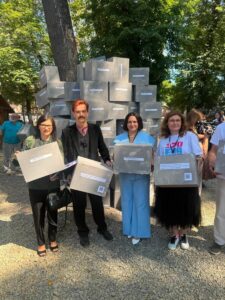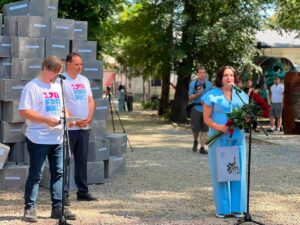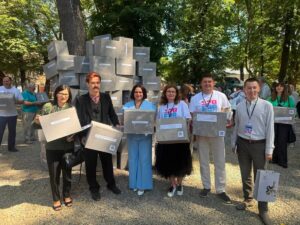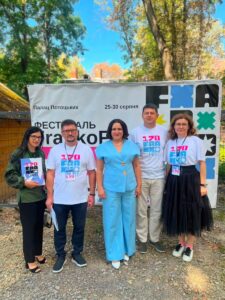
FrankoFest 170 , a large-scale cultural and scientific festival dedicated to the 170th anniversary of the birth of Ivan Franko, has started in Ivano-Frankivsk . Vasyl Stefanyk Carpathian National University is one of the co-organizers of the festival and is participating in its holding with scientific and cultural initiatives.
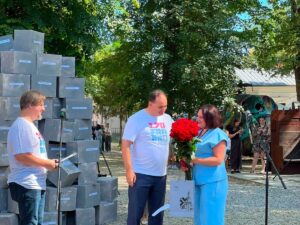
The opening of FrankoFest 170 was attended by the rector of the Vasyl Stefanyk Carpathian National University, Valentyna Yakubiv .
An important scientific component of the festival was the All-Ukrainian Scientific Conference “The Spirit That Tears the Body to Battle”: The Potential of the Creative Thought of Ivan Franko and Vasyl Stefanyk , organized by scientists from the Department of Ukrainian Literature of Carpathian University.
The conference brought together scholars, researchers, and teachers who study the creative heritage of Ivan Franko and Vasyl Stefanyk, as well as everyone who is close to Ukrainian culture, history, and the power of the Ukrainian word.
During the opening, Valentyna Yakubiv emphasized the special importance of the figures of Ivan Franko and Vasyl Stefanyk for the formation of Ukrainian culture, national consciousness, and public opinion. According to her, understanding the creative heritage of prominent Ukrainians helps the modern generation better understand their own history, identity, and the Ukraine we are creating today.
During the conference, participants spoke about the creativity, ideas, and social significance of Franko and Stefanyk, as well as the relevance of their intellectual heritage for modern Ukrainian society.
FrankoFest 170 is intended to become a space for scientific dialogue, cultural reflection and new discoveries, affirming the living connection between the heritage of great Ukrainian artists and modernity. For Carpathian University, participation in the festival is an opportunity to contribute to the preservation and popularization of Ukrainian cultural heritage and at the same time demonstrate a modern reading of the work of Ivan Franko and Vasyl Stefanyk.