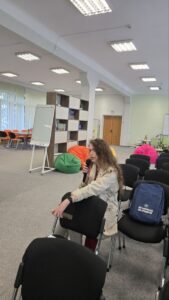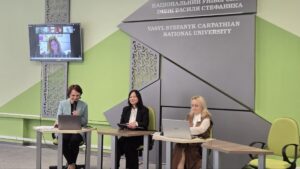
An international roundtable “Advancing Gender Equality in Higher Education: Leadership, Well-Being and Institutional Practices” was held at the Vasyl Stefanyk Carpathian National University within the framework of the EDUC-WIDE project. The event was held in a hybrid format and brought together researchers, academic and administrative staff, specialists in the field of gender equality, leadership, well-being and institutional development.
The aim of the roundtable was to create a space for interdisciplinary dialogue on contemporary approaches and practical tools for promoting gender equality in the university environment. The focus was on issues such as raising gender awareness among researchers, structural barriers to female leadership and career development, gender-related burnout, and integrating gender equality principles into everyday academic practices and institutional policies of universities.
Liliya Turovska, Vice-Rector for Scientific and Pedagogical Work and International Activities of the Carpathian National University, welcomed the participants. Iryna Hryhoruk, Head of the Research Department and Project Manager at the Carpathian National University, spoke about the main tasks and activities of the EDUC-WIDE project. The round table was moderated by Tetyana Solodzhuk, Head of the Project Management Department, who is responsible for gender mainstreaming tasks within the EDUC-WIDE project, and translation was provided by Kateryna Kobuta, a translator from the International Relations Department.
The thematic part was opened by Claudia Dell’Uomo d’Armé from the University of Paris-Nanterre, who offered an interdisciplinary perspective on the formation of gender awareness among researchers. Her presentation emphasized that gender awareness is not only a body of knowledge, but also a process of critical reflection and rethinking of established academic and professional practices.
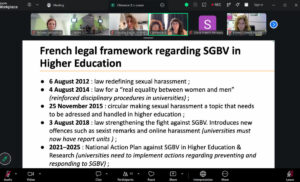
The practical institutional dimension of the topic was continued by Louise Lavallée and Clémence Biegel from the same university. They presented the university’s experience in combating gender-based violence. Their presentation demonstrated the importance not only of awareness of the problem, but also of creating effective university mechanisms, procedures and support structures. One of the important factors in the effectiveness of their university’s gender policies is the involvement of employees in gender equality activities through support, motivation and encouragement, rather than through coercion.
Of particular interest to the participants was Emma Gómez Nicolau’s presentation on structural barriers to feminist leadership in academia from Jaume I University. The researcher examined the so-called academic “sandwich model”, noting that much of the work that supports university communities – mentoring, emotional support, care and mediation – often remains invisible in formal assessment systems. At the same time, it is women and early-career researchers who often take on a disproportionate share of this work, which can impact their opportunities for scientific productivity and career development.
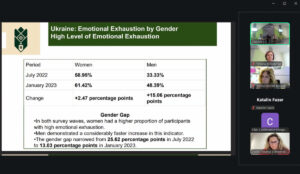
An important component of the roundtable was the report of Larisa Zahrai, Doctor of Psychological Sciences, Professor, Dean of the Faculty of Psychology of the Kyiv National University, on the topic “Emotional Burnout as a Gender Marker: Challenges for Higher Education”. The presentation analyzed how gender roles, social expectations, work-life balance, and institutional conditions can influence the manifestations of professional burnout. It was emphasized that gender differences in the manifestations of burnout are not biologically determined, but are largely related to social roles, expectations, and practices of the organizational environment.
Particular attention was paid to the Ukrainian context, in which academics are additionally affected by war, security risks, economic instability, increasing professional and administrative workload, and the need to combine work, family, and community responsibilities.
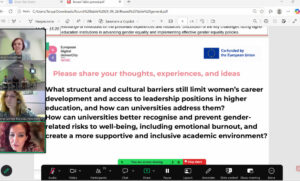
Following thematic presentations, participants discussed what structural and cultural barriers still limit women’s career development and their access to leadership positions in higher education, as well as how universities can better recognize and prevent gender-related risks to employee well-being, including burnout, and create a more supportive and inclusive academic environment.
The roundtable demonstrated the multidimensionality of the issue of gender equality in higher education. Gender awareness, institutional responsibility, leadership, combating gender-based violence, recognizing invisible work and care, and the psychological well-being of the academic community are closely interconnected components of the sustainable development of a modern university.
One of the key conclusions of the meeting was the understanding that real gender equality requires more than formal policies and declarations – it involves constant reflection, institutional support, open dialogue, and practical changes in the daily life of the university community.
The event was held within the EDUC-WIDE project, funded by the European Union under Grant Agreement No. 101136533.