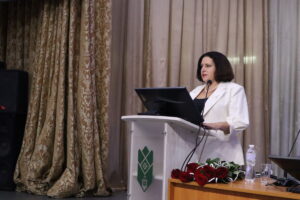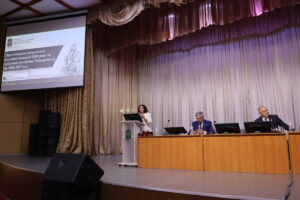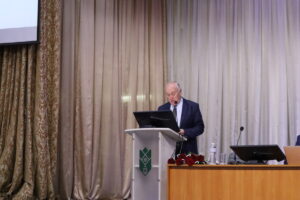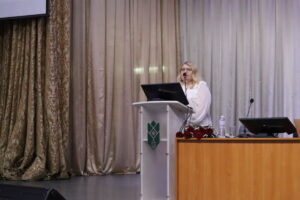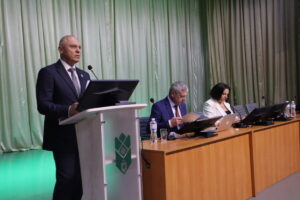
Today, during a conference of the staff of the Vasyl Stefanyk Carpathian National University , the rector of the university, Professor Valentyna Yakubiv, presented the preliminary results of the 2026 admission campaign and outlined the priority tasks of the staff for the 2026–2027 academic year.
The rector noted that this year’s admission campaign demonstrates positive dynamics in key indicators. In particular, the university ranked 6th among higher education institutions in Ukraine in terms of the number of applications submitted for bachelor’s degrees .
Compared to 2025, the number of applications submitted for bachelor’s degrees increased by 37.1% .
Among the educational programs that have become the most popular among applicants to the bachelor’s level are “Psychology”, “English Language and Literature and a Second Foreign Language”, “Logistics”, “Marketing”, “Law”, “Elementary Education”, “Rehabilitation Psychology”, “Software Engineering”, “Business Administration”, “Accounting and Taxation” .
According to the number of enrolled applicants, a dozen leading departments were formed:
- Department of Social Psychology;
- Department of Management and Business Administration;
- Department of English Philology;
- Department of Management and Marketing;
- Department of Crime Control Policy and Criminal Law;
- Department of Primary Education and Educational Innovations;
- Department of Clinical and Rehabilitation Psychology;
- Department of Information Technology;
- Department of Finance;
- Department of Accounting and Taxation.
The dynamics of the number of applicants with high scores is also positive. In 2026, 59 applicants with scores at the level of 200 points were enrolled in the university , while last year there were 45 such applicants.
Separately, Valentyna Yakubiv presented the results of the college admissions campaign.
The number of college applications increased by 72.2% compared to last year, and the number of admitted students increased by 20.9% .
In general, the dynamics of the main indicators of the 2026 admission campaign compared to 2025 is as follows:
- the number of applications submitted for bachelor’s degrees — +35.3% ;
- maximum volumes of state orders for bachelor’s degrees — +21.3% ;
- the number of enrolled undergraduate students — +18.1% ;
- the number of applications submitted to college — +72.2% ;
- the number of enrolled college students — +20.9% .
According to the rector, these results demonstrate the growing interest of applicants in the university and its educational opportunities, and also create the basis for further development and improvement of the educational environment.
Priority tasks for the 2026–2027 academic year
Continuing her report, Valentyna Yakubiv outlined the key tasks facing the university staff in the new academic year.
Educational process
Among the priorities:
- updating the list of educational programs in accordance with the results of the admission campaign and the needs of the labor market;
- strengthening the internal system of ensuring the quality of education and accreditation readiness;
- introduction of microcredit certificate programs;
- strengthening the practical training of applicants and connections with the professional environment through the introduction of elements of dual training;
- implementation of distance learning programs;
- continuing the digitalization of basic procedures of the educational process and regulating the use of artificial intelligence.
An important area of work remains increasing the university’s scientific performance.
In particular, an increase in the number of publications in publications indexed by the scientometric databases Scopus and Web of Science is envisaged , with a special emphasis on publications Q1–Q2 .
It is also planned to systematically expand the university’s participation in project and grant activities – Horizon Europe, Erasmus+ competitions , programs of the Ministry of Education and Science of Ukraine, the National Research Foundation of Ukraine, and other international and national programs.
Among the tasks is to increase the amount of attracted funding for scientific and innovative activities, in particular grant funds, economic contract topics, and funds from the commercialization of research results.
Special attention will be paid to involving students and young scientists in real research and project work – participation in scientific projects, competitions, and conferences.
Another strategic direction is to strengthen the university’s international integration.
It is planned to expand the participation of students and employees in international academic mobility programs, as well as develop international scientific cooperation with specific results – joint publications, project applications, research, scientific events, and the use of research infrastructure of foreign partners.
An important task will be to involve foreign teachers and scientists in teaching, conducting research and scientific activities, as well as launching joint educational programs and double degree programs with partner universities.
A separate block of tasks concerns the development of the university’s human potential.
The rector emphasized the need to implement a holistic system of professional and career development of employees , which will provide individual development trajectories, professional training, and career counseling in the context of digital transformation.
It is also planned to strengthen the institutional culture of mentoring, coaching, mutual development and support for the professional development of employees, as well as the development of their leadership potential.
Among the priorities are improving and scaling the performance management system, recognizing and motivating employees, and creating a university environment of well-being, inclusion, and support for applicants and employees.
An important direction remains the development of the leadership, civic, and volunteer potential of the student community , as well as systematic work on attracting, developing, and retaining talent.
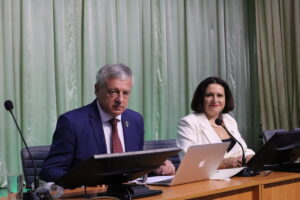
After the conference of the work team, a meeting of the Academic Council of the Vasyl Stefanyk Carpathian National University was held .
The meeting considered a number of issues related to the organization of the work of the Academic Council, the development of the university, personnel decisions, and digital transformation.
In particular, the Chairman of the Academic Council, Professor Ihor Tsependa, reported on changes in the composition of the University’s Academic Council, the composition of the counting commission, nominations for awarding state and departmental awards of the Ministry of Education and Science of Ukraine, approval of the work plan of the University’s Academic Council for 2026–2027 academic year, and the renewal of the composition of the permanent commissions of the Academic Council.
Tetyana Kornienko spoke about the Digitalization Strategy of Vasyl Stefanyk Carpathian National University for 2027–2032.