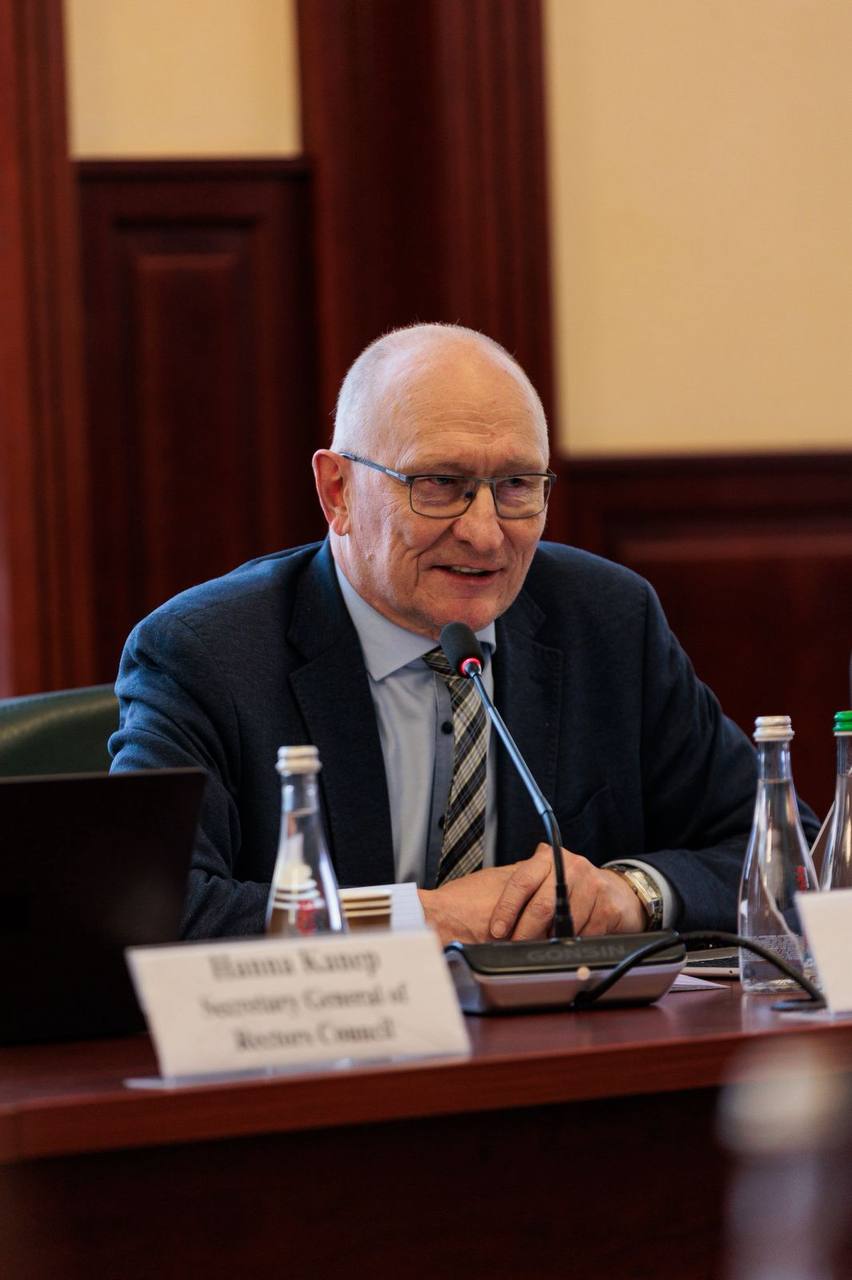

Valentyna Yakubiv, Rector of Vasyl Stefanyk Carpathian National University, and Dmytro Romanyuk, Chairman of the Supervisory Board, participated in a joint meeting of three universities — participants in an experiment to expand the autonomy of higher education institutions by launching authorised supervisory boards.
The event took place within the framework of the UA–EST Higher Education Policy Project, aimed at strengthening higher education reform in Ukraine, with an emphasis on modernisation and the implementation of a modern personnel policy.
The following people addressed the participants with welcoming words:
• Mykola Trofymenko – Deputy Minister of Education and Science of Ukraine;
• Roman Hryshchuk, Committee of the Verkhovna Rada of Ukraine on Education, Science and Innovation;
• Jaak Aaviksoo – project consultant, former Minister of Education and Science and Defence of Estonia, Vice-Rector of the University of Tartu and Tallinn University of Technology.
During the event, the vision and practical cases for transforming university governance under conditions of expanded autonomy were presented.
In particular, Petro Chernyshov presented the case of the transformation of Kyiv Aviation Institute from a budget institution to a corporate governance model with increased financial autonomy, supported by an independent supervisory board.
In her speech, Valentyna Yakubiv presented a report on the topic “Government Pilot by the Ministry of Education and Science of Ukraine in Universities: Interim Results, Challenges and Expectations”, in which she informed about the interim results of the experiment at Vasyl Stefanyk Carpathian National University.
The rector of our university, Valentyna Yakubiv, focused on the university’s key achievements, including:
• implementing changes in the corporate governance system and the role of the Supervisory Board;
• updating the personnel management system in accordance with modern management approaches;
• development of interaction with stakeholders as an element of open university governance;
• improving the efficiency of operational management through the introduction of KPIs.
The final part of the event was an open discussion and question-and-answer session, during which participants discussed the challenges of implementing the experiment, expectations from state policy in the field of university autonomy, and the possibilities of scaling the developed management models.