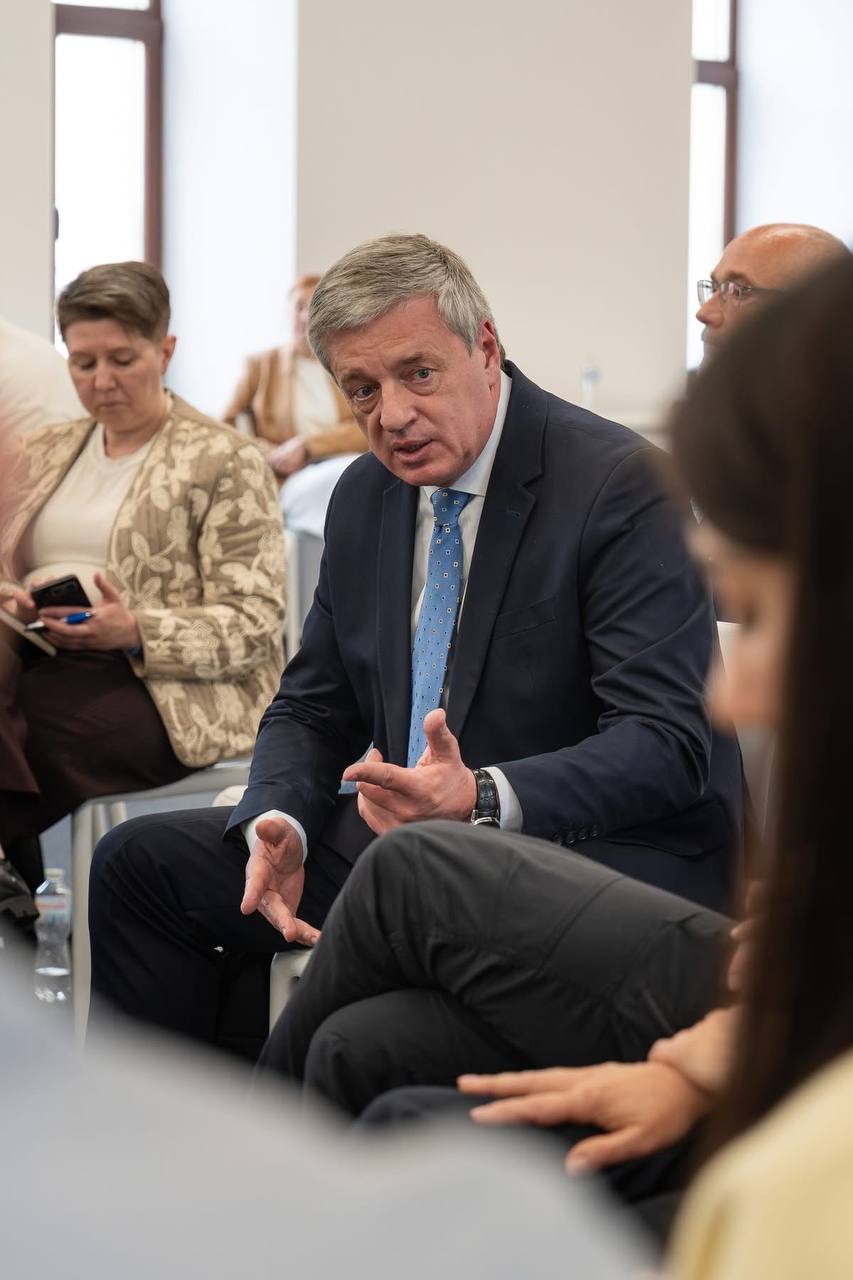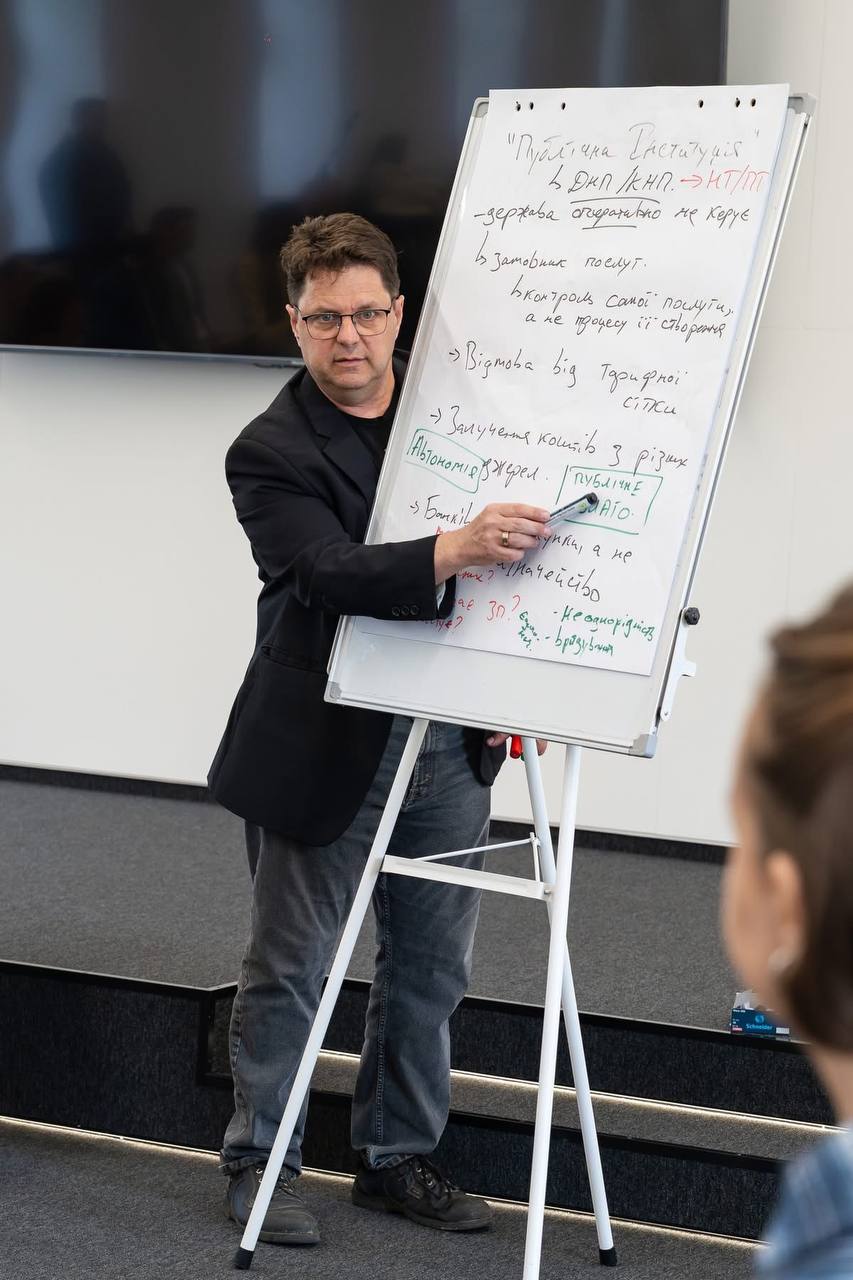

An expert discussion dedicated to the development and strengthening of the autonomy of public institutions in the spheres of culture, healthcare and higher education was held at the National University of Kyiv-Mohyla Academy. The event was attended by Ihor Tsependa, Advisor to the Minister of Education and Science of Ukraine and Chairman of the Academic Council of Vasyl Stefanyk Carpathian National University.
The discussion was also joined by Deputy Prime Minister for Humanitarian Affairs of Ukraine Tetyana Berezhna, Chairman of the Verkhovna Rada Committee on Education, Science and Innovation Serhiy Babak, Chairman of the Supervisory Board of NaUKMA Gennady Zubko, President of NaUKMA Serhiy Kvit, co-founder of the “Believe in Yourself” Charitable Foundation Iryna Ivanchyk, Director General of the Mystetsky Arsenal Olesya Ostrovska-Lyuta, Ambassador of Ukraine to the United States (2021–2025) Oksana Markarova, and other experts in the fields of education, culture and healthcare.
During the discussion, participants discussed mechanisms to strengthen the independence of public institutions, the role of supervisory boards, financial autonomy, effective property management, and transparency of activities.
In his speech, Ihor Tsependa emphasised: “Ukraine needs not just a new organisational and legal form, but a new philosophy of managing public institutions. Autonomy does not mean weakening the state or refusing responsibility. On the contrary, it is a transition from manual management to trust, accountability, and strategic development.”
The Chairman of the Academic Council of Carpathian University also emphasised the importance of the modern model of university governance: “A university is an autonomous academic community that creates public good through education, science, innovation, and the formation of human capital. That is why at Vasyl Stefanyk Carpathian National University, we are developing a model of balanced governance – interaction of the Supervisory Board, the Rectorate, the Academic Council, the Conference of the Labour Collective, and the Student Senate. Complex public institutions require not the concentration of power, but a system of balance and responsibility.”
The participants in the discussion paid special attention to the international experience of the USA, Canada, Poland, and Estonia in university and public institution management.
Ihor Tsependa emphasised that the European experience demonstrates the possibility of a harmonious combination of autonomy, professional management and academic self-government: “The Polish experience is convincing: it is possible to modernise university management, strengthen autonomy and professional management without destroying academic self-government and the public mission of the university. The university of the future is an autonomous public institution of the European type, working for society, the state and future generations.”
The participants in the discussion agreed that the development of strong, independent, and accountable public institutions is an important condition for modernising the state, overcoming post-Soviet management practices, and improving the quality of public services.